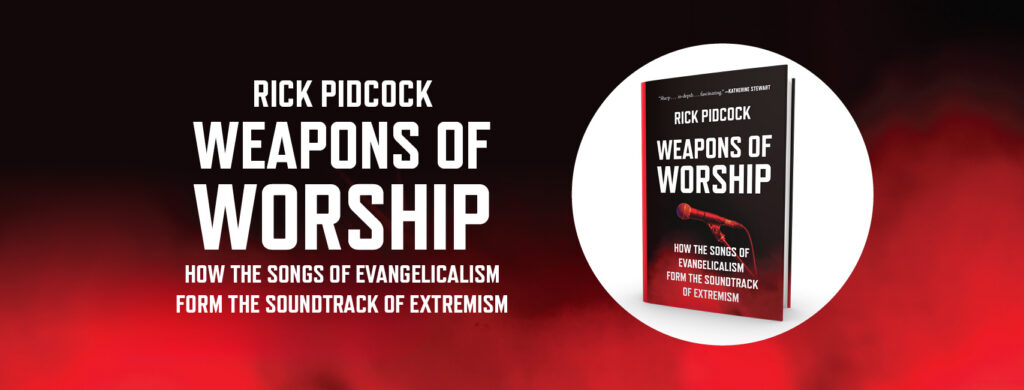
Praise for Weapons of Worship

Blending sharp analysis, in-depth reporting, and insights gleaned as a former worship leader, Pidcock offers a fascinating insiders’s guide to the music industry aimed at white evangelical audiences. Along the way he unpacks the idea of worship music as political warfare, deftly showing how its power dynamics of authority and submission help sacralize the drive to a theocratic and autocratic order.

With a worship leader's insights and a journalist's shrewdness, Rick Pidcock peels back the appealing façade of the evangelical worship music industrial complex. In the process, he exposes some of the foundational infrastructure for the authoritarian turn in modern American Christianity.

Contemporary worship music has become the soundtrack of faith for multiple generations of American evangelicals. The ecumenical appeal and emotional resonance of singable, tuneful, anthemic worship songs has given them broad reach and, in some cases, utility for those seeking to mobilize religious fervor for political ends. Pidcock demonstrates that contemporary worship music has become a weapon in the culture wars, tracing a web of connections between people, institutions, and songs. Weapons of Worship is a provocative and compelling exploration of the ways some of today's most-loved songs of faith and their powerful associations can be used to divide rather than edify.

Weapons of Worship educates, illustrates, and motivates. Rick Pidcock's experience as a worship leader and journalist enables him to give us a clear picture of the power and influence of white evangelical music to fuel christian nationalism in both subtle and overt ways. As a preacher and decent musician, I often get to participate musically in churches and have been surprised at the ubiquity of contemporary white christian music—even in churches where the majority of people are not white, including some churches outside of the USA. Weapons of Worship explains the business of Christian music as well as its theological and cultural perspectives. Pastors, lay people, and educators will find this book illuminating and hopefully propel us all to think seriously about what it means to worship God with music.

Stories about Christian Nationalism tend to focus on politicians and preachers. In Weapons of Worship, Rick Pidcock makes a compelling case for why we should be listening much more closely to the music.
Drawing on his decades as an evangelical worship leader, along with on-the-ground reporting, Pidcock reveals how the songs played on Christian radio and before Sunday services have become some of the most powerful forces of radicalization in American Christianity.
Weapons of Worship is deeply informed and very unsettling. Once you read it, you'll never listen to worship music the same way again.

Those who’ve deconstructed their faith know there’s a point at which we make a full turn and examine our complicity. Weapons of Worship is the work of a brave and honest worship leader turned journalist, willing to critique the system he participated in, and explain how and why evangelical music is weaponized. As a fellow survivor of religious trauma, who carries a music wound from songs I can’t forget, and from weaponized, emotional worship as the sound of war, it helps me heal to better understand the sound engineering behind the political movement and orchestrated agenda. Weapons of Worship is relevant and timely, and will help readers understand how they’re both triggered and manipulated by the music authoritarian regimes use to take control without consent.

Now more than ever, this is the book we need to understand how the worship music of evangelicalism is being used to infuse transcendent fervor into authoritarian politics and to fuel an anti-democratic movement toward theocracy.

Be forewarned reader: like you, I matured as an evangelical Christian through the songs Rick Pidcock writes about. But the story he tells about these weapons of worship is disturbing. Like you, I can’t unhear the songs that made me. This book can help us all sing different ones. Rick masterfully draws a clear line from our beloved lyrics about our great God to lionizing authority, racism, and nationalism. And that weaponization occurred through worship leaders. People may know about Sean Feucht, the zany, long-haired guitar troubadour who has led national worship tours. But what they get from this book is the algorithm of abused scripture, catchy lyrics, and not a little arena-style technology that made him the Christian Nationalism celebrity he is. So many books have been written about that last ideology in recent years, including one by me. What was missing was one about worship. And only a former worship leader like Rick could do it justice.

One of the greatest joys of my career has been meeting and publishing Rick Pidcock. His voice is what we need in this time. He brings the background to interpret Christian nationalism and male hierarchy to a larger audience. He’s a frontline war correspondent in the battle for America’s soul.

Weapons of Worship is a book that every evangelical Christian around the world needs to read to fully grapple with the systems of Empire we unknowingly fuel in the name of worship. This book is undoubtedly a challenging read; especially for those of us like myself who were once part of these Empire-shaped systems and churches that Rick is unafraid to call out by name. The truth that Rick Pidcock shines a light on throughout this book will set us all free - if we let it. You will never see the Contemporary Christian Music industry or its music in the same way again after reading this book.

A trenchant look at an underexplored element of today’s Christian nationalism.